

Title Register and Title Plan compared
| Your question | Title Register | Title Plan | | --- | --- | --- | | Who is the registered owner? | Registered proprietor entries | Not the ownership record | | Is the title freehold or leasehold? | Tenure and title description | Read alongside the register | | What land is included? | Written property description and references | General mapped extent | | Are there mortgages, rights or restrictions? | Entries and references where recorded | May show areas referred to by the entries | | Where is the exact fence line? | May contain relevant wording or deed references | Normally general boundaries, not an exact surveyed line |
**Choose the register** for a written title enquiry. **Choose the plan as well** when the location or extent matters. Neither document is a substitute for the other, and neither guarantees an answer to every property question.
What the Title Register tells you
The register is organised into sections. The Property Register describes the land and tenure and may record rights benefiting it. The Proprietorship Register identifies the registered owner and may contain restrictions. The Charges Register can contain mortgages and other matters affecting the title. What is recorded varies; some details are in a separately referenced deed. If your question is simply who is registered as owning a particular title, start here. If a right or covenant is unclear, the entry may point you towards another document rather than giving the complete wording. Read our [Title Register guide](/title-register) for more detail. Official source: https://www.gov.uk/government/publications/how-to-read-a-title-register-and-title-plan/how-to-read-a-title-register
What the Title Plan adds
The plan connects the written description to a mapped area. Red edging normally indicates the registered extent. Other colouring or markings should be read with the corresponding register entries, not interpreted as a universal code. Use the matching title number to keep the plan and register together. The [Title Plan guide](/title-plan) explains the document in more detail. For a boundary-focused enquiry, our [property boundary maps guide](/property-boundaries) also explains the separate, indicative GPS report where available. Official source: https://www.gov.uk/government/publications/how-to-read-a-title-register-and-title-plan/how-to-read-a-title-plan
See the difference in redacted examples
Written title record
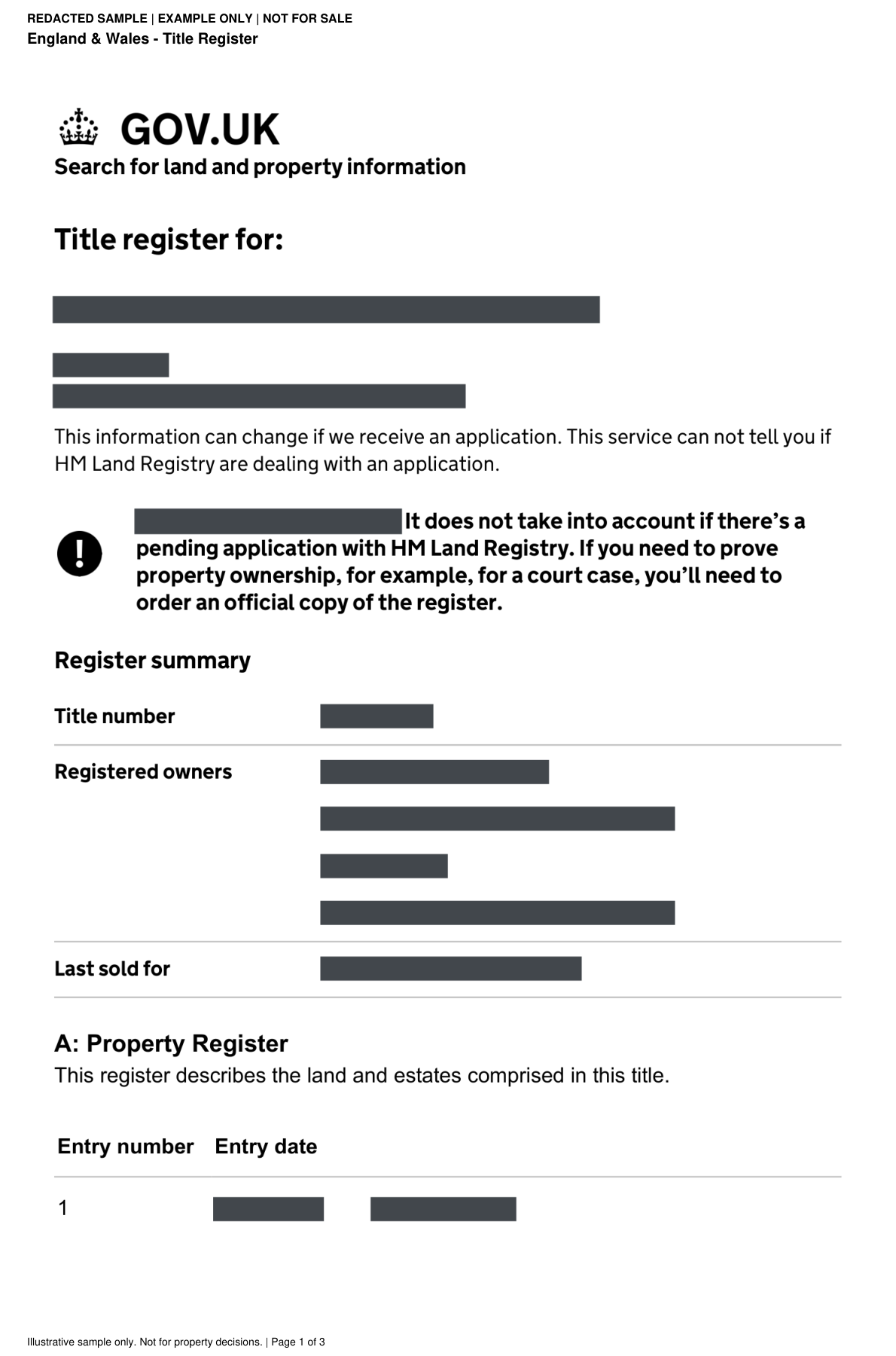 *An example of the written record, not a result for your property. [Open the redacted Title Register PDF](/document-examples/england-wales-title-register/sample.pdf).*
Mapped title extent
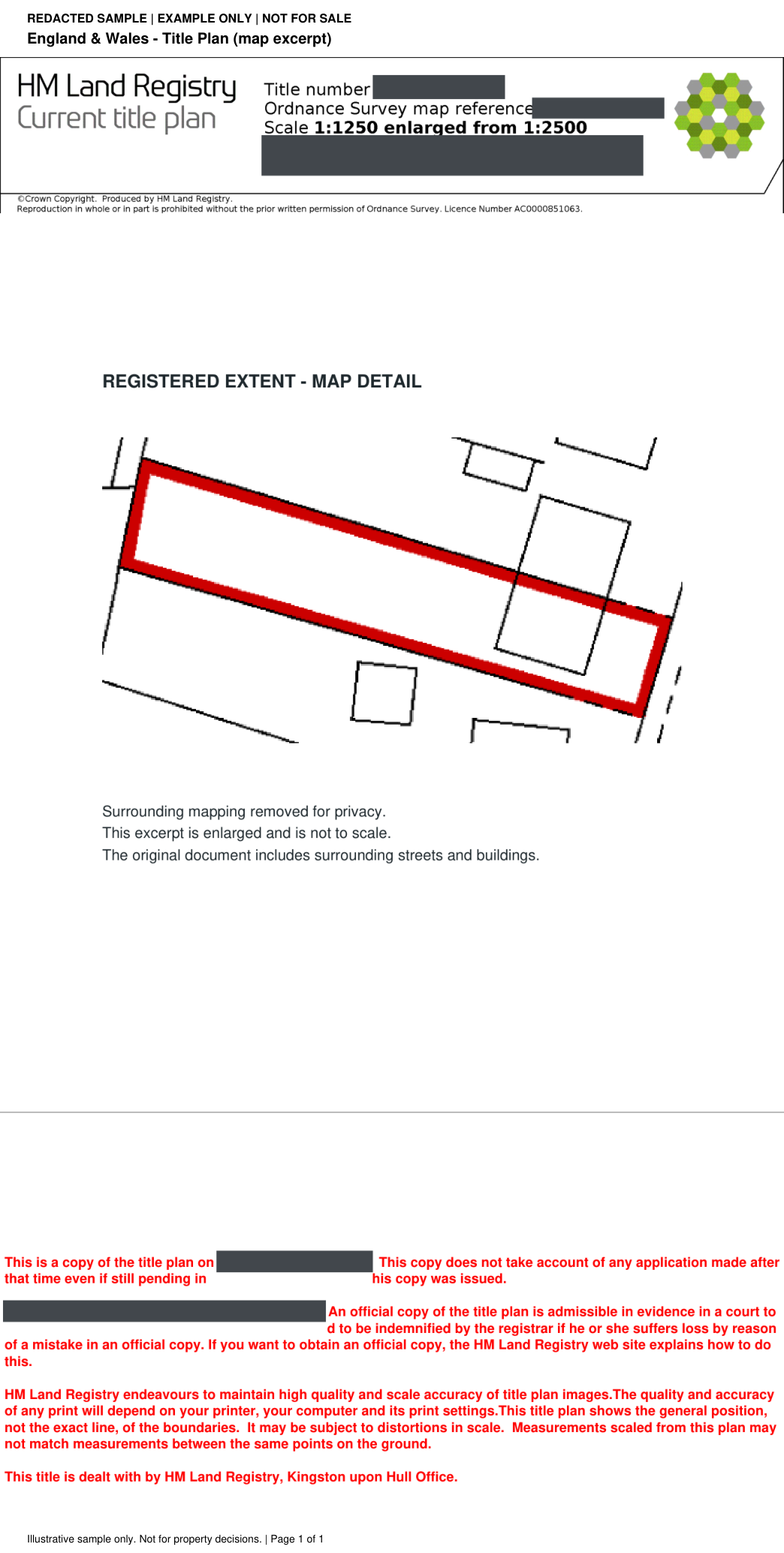 *The surrounding map and identifying details are redacted in this example. It is not to scale and must not be used to measure land. [Open the redacted Title Plan PDF](/document-examples/england-wales-title-plan/sample.pdf).*
Which document fits your enquiry?
- **Checking an owner:** start with the register for the relevant title. A plan alone does not supply the proprietor entries.
- **Understanding a garden, accessway or adjoining strip:** read the plan and register together. Check whether the land you are interested in belongs to a separate title.
- **Understanding a right of way or restriction:** start with the register, then check any plan reference or separately filed document it identifies.
- **Reviewing a boundary disagreement:** both documents may help establish context, but general mapping does not determine a disputed fence position or who must maintain it.
Why one address can have more than one title
One street address is not a guarantee of one title. A flat may have a leasehold title alongside a freehold title; a garage or adjoining land may be registered separately. Check the property description, tenure and title number against the land you actually want to investigate before relying on a document. Do not assume that the first plan returned covers every piece of land associated with an address. If the relevant title is unclear, further registry enquiries or professional help may be needed.
Boundaries, deeds and formal copies
Most Title Plans show general boundaries, not the precise legal boundary on the ground. Increasing the zoom, tracing the line or adding GPS coordinates does not turn that mapping into a survey. See [does a Title Plan show exact boundaries?](/does-title-plan-show-exact-boundaries). The phrase Title Deeds is also used for different documents. Our [Title Deeds guide](/title-deeds) separates the register-and-plan bundle from original paper deeds and separately filed historic records. If you need proof of ownership for a formal purpose, read [digital copies versus official copies](/official-copy-documents) before ordering. Official source: https://www.gov.uk/your-property-boundaries
Property outside England and Wales
Scotland uses Title Sheet and Title Plan terminology for its registered title documents; Northern Ireland uses a folio and map. Their registry systems and copy requirements differ. Start with [Scotland property records](/scotland-property-records) or [Northern Ireland property records](/northern-ireland-property-records) rather than assuming every detail of this comparison applies across the UK.
Ordering through Land Registries
Use the existing property search to check the address and available documents, then review your selection and current price before payment. Available documents are emailed after processing. No search guarantees that a particular document exists or that it will answer a legal question. LandRegistries.com is an independent service, not HM Land Registry or another government registry. You can also obtain available records from the relevant official provider. This guide is general information, not legal or surveying advice.